
By Gregory
 Beginning this past September, I took on the position as the advisor for the East Regional Club for the North Carolina American Red Cross Youth (also written as “RCC East”), helping develop new leaders within the club’s executive council during the 2024–2025 school year. Overall, NC American Red Cross clubs empower youth volunteerism and leadership by providing high school and college students with volunteer opportunities that align with the American Red Cross’s mission, which is incorporated into different service lines of unique opportunities available to volunteers to support their communities. These clubs typically come in two forms: school-affiliated or regional clubs. School clubs are centered at a particular school, such as Duke’s American Red Cross Club, where the club’s members are all students at the school of interest and have access to school-specific opportunities that the club’s executive team may organize. In contrast, regional clubs serve to blanket regions of NC for youth volunteers who do not have a school club or are looking for additional opportunities outside of school, such as the NC Red Cross East Region Youth Club, which provides volunteer opportunities to those in eastern NC, like in the Fayetteville or Cape Fear areas. Before becoming the advisor of this club, I gained experience supporting the Red Cross’s youth volunteerism efforts while serving as the president of my high school’s club. As the president of my high school’s Red Cross club, I had the opportunity to organize and facilitate numerous volunteer opportunities, which helped our club record over 2,500 service hours from July 2022 to July 2024. I realized that my responsibilities would change with becoming the advisor for a club, in contrast to serving as an officer. As the RCC East advisor, my responsibilities have shifted toward helping the club’s officers organize opportunities for all volunteers while fostering teamwork and leadership among the club’s officers.
As part of my role, I oversee the development of our club’s opportunities, guiding the officers in creating the necessary materials and promoting the opportunities to members. At the beginning of the school year, our club created a general plan that outlines our year-long opportunities and when certain seasonal opportunities would be held. Below is the plan that we followed throughout the year:
- September – Officer Welcome, introducing our club’s 2024-2025 officers to the club members.
- October – Disaster Preparedness Topics, such as discussing ways to prepare for various natural disaster scenarios.
- November – Holiday Donation Drives, collecting cards and clothing for veterans.
- December – Holiday Donation Drives (Continued)
- January – Service to the Armed Forces Snack Drive, collecting snacks for veterans and their families.
- February – SAF Drive (continued) / Measles and Rubella (M&R) Fundraiser, raising money to support vaccination efforts for youth.
- March – Measles and Rubella (M&R) Fundraiser
- April – Officer Elections, electing officers for the 2025-2026 academic year.
- May – End of Year / Member Recognition, recognizing our club’s volunteerism throughout the year.
With this plan, we can organize and plan our meetings well in advance to ensure that we can effectively carry out our club’s opportunities throughout the school year, such as our club’s November holiday donation drive. Typically, when organizing events for a broad audience, it is crucial to consider ways to ensure that all members have fair opportunities to engage with the resources we provide to members, as these opportunities are made to serve members throughout the entire eastern region.
- For instance, we realized it would be challenging to find drop-off locations that would accommodate as many volunteers as possible while increasing our outreach beyond our virtual club meetings. Ultimately, we organized the drive to have many drop-off locations within different locations of the NC Red Cross’s East Region, spanning from Greenville to Wilmington, to ensure that most members had a nearby drop-off site. Likewise, we incorporated a mailing option for volunteers to mail the materials they want to donate as an alternative method.
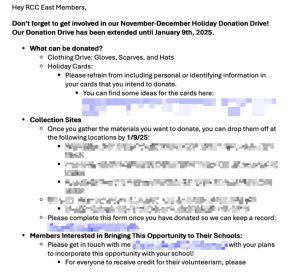 To support the officers’ promotion efforts, I helped draft a comprehensive email to the over 130 members in our club at the time, containing information on items that could be donated, the various drop-off locations, and general participation guidelines. This email also addresses the logistical aspects of keeping this drive organized by having members log their donations, ensuring that all members receive the proper credit for their contributions. Likewise, it details how volunteers can recruit their peers interested in the donation drive to register for our club so they can also receive credit for their volunteer service.
- Along with this email, additional informative emails were sent out with reminders throughout the collection period to encourage volunteers to participate in our donation before its deadline, ensuring that all volunteers are aware and have ample time to collect donations.
Following a similar approach, our club also held a snack drive to collect snacks for veterans and their families at Fort Bragg during January and February.
 As the club’s advisor, I also altered the club’s collaborative structure to give the officers more input into the club’s planning and organization. For instance, I shifted our club’s officer meetings toward being more open-ended, asking the officers questions like “What do you want to discuss during this meeting?” or “Is there anything that you think would be beneficial in recruiting members or increasing engagement?” With these questions, my primary goal was to encourage the officers to share their perspectives on ideas for meeting planning, opportunity development, and opportunity promotion, providing them with opportunities to build and show their leadership qualities. Similarly, another benefit of having open-floor officer meetings is that all officers have equal opportunities to pitch ideas or adjust the meeting’s plans, meaning that regardless of the officer’s predetermined role, they can continue to be generally involved in our club’s meeting plan. In addition to opening the floor for more officer-led organization and planning, I aim to use the upcoming months to help foster consistent leadership among the officers by assigning a particular opportunity to each officer that they can research and specialize, meaning that each officer should have an aspect of the club that they can lead during the meetings and behind the scenes. For instance, a particular officer can lead our club’s donation drive efforts while another officer can lead our club’s member engagement, helping create consistency in the assigned responsibilities for the officers. This specialization would streamline our club’s efforts in managing numerous opportunities per meeting, as each officer leads their own portion of the club while having support from others through discussions during our club’s officer meetings.
To support our club’s recruitment efforts, I also took on the responsibility of onboarding new members, primarily helping them acclimate to our club’s opportunities before attending the monthly club meetings. My primary role is to reach out to prospective members and organize calls with them to discuss the various opportunities that the Red Cross provides to youth club members, as well as the multiple resources that members can use to find different opportunities. For instance, I discuss the Red Cross’s Mission Statement and tie it into the opportunities that our club has done recently, such as our club’s collection drives for veterans, to introduce new members to the opportunities they can expect from our club.
I would like to conclude this blog by recognizing my supervisors, as well as the club’s officers, for their continuous support of the club throughout the year. I hope everyone enjoyed reading this blog!
